
Smoke on the Water — Selling Marine Diesel Particulate Filters
A look at the dubious claims circulating in the marine DPF market — and what actually works for soot removal on a yacht's generators.
Talk about blowing smoke — a few of the claims made by new entrants to the marine diesel particulate filter market might fairly be described as smoke and mirrors, or at best a dose of hot air.
One of the more dubious claims, made on websites and service-truck doors, is "up to 99%" reduction in soot production.
DPFs are based on mature, regulated technology.
Millions of particulate filters have been installed since being mandated on diesel-powered trucks in 2007. The filter elements used in marine DPFs are nearly identical to those used on mobile and many stationary diesel exhaust systems.
The large body of research from the diesel industry and regulators defines particulates as PM2.5 (2.5 microns or less) and ultrafine particles under 0.1 micrometer. Filter efficiency is measured as the percentage of particles above 0.2 microns removed from the exhaust stream. The figure most commonly cited by manufacturers and regulators is between 90% and 98%.
It's possible to capture 99% or more, but only by making filter passages so small that they impose a large restriction on exhaust flow and create engine-damaging back pressure. Lower back pressure and good filtration can be obtained with a larger filter, but that runs into diminishing returns — more engine-room volume, problematic regeneration from uneven internal flow patterns, and poor heating (hot in the center, cold on the outside). That leads to reduced service life and higher back pressure.
Bottom line on efficiency claims: a clogged filter is the most efficient — at 100%, it will not allow any exhaust gas to flow.
"No heat generation" is another claim that should embarrass advertisers.
Regeneration — the removal by combustion of captured particulates — generates additional heat. Virtually all filters are coated with a catalyst that promotes ignition of particulates at a temperature lower than their self-ignition temperature. The heat released by combusting those particulates and unburned hydrocarbons raises the filter and exhaust gas above the filter-inlet temperature. The only way to limit increases in engine-room temperature is by using an experienced marine exhaust company known for careful attention to the design and installation of insulation blankets.
Passive regeneration is, at best, faith-based.
Passive systems have left many owners and engineers with regrets. Horror stories of systems failing within a few hundred hours or a few short weeks are common.
Exhaust gases entering a passive filter have to be hot enough to start a chemical reaction between particulates and the filter catalyst. Many generators can produce gas at the required temperature — but only when run at a high percentage of load for long enough to complete regeneration. If you're considering a DPF, it's probably because your generators are running dirty. They probably run at low loads and never meet the minimum conditions required for passive regeneration. The major source of soot is poor combustion, and poor combustion rarely creates exhaust temperature high enough to regenerate a passive filter.
Salesmen who promote passive filters often claim special catalysts that initiate regeneration as low as 250°C. The catch: the precious-metal catalysts on those filters were developed for highway vehicles required to burn fuel with less than 15 ppm sulfur. Sulfur is a poison to precious-metal catalysts — it kills them chemically and coats survivors with an impervious layer.
If you operate your yacht only in North American waters and avoid most of the Caribbean and Eastern Mediterranean, passive filters might work. If you load fuel anywhere else, the chances of being delivered a high-sulfur load are very high. Even when ULSD is ordered and the bunker ticket says so, we've found yachts with sulfur content above 600 ppm — after dilution from later fuel loading.
SeaClean® is an active DPF system.
EnerYacht — the developer of SeaClean — began by retrofitting its patented thermal-management components to failed passive systems. Those retrofits saved a lot of embarrassment, but only delayed the inevitable (and expensive) replacement of the passive filter.
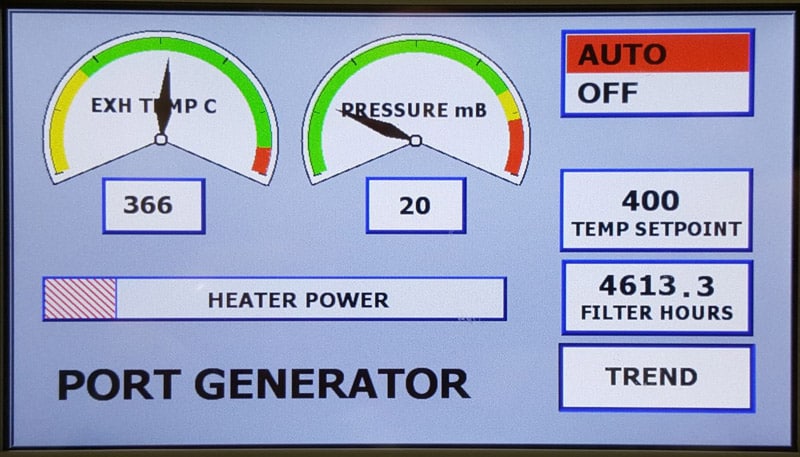
SeaClean is the culmination of decades of hands-on operational experience with marine diesel engines and decades of D'Angelo Marine Exhaust's manufacturing and installation expertise across commercial, recreational, and military applications. It's the first and only truly successful electrically heated active particulate-filter system. Its patented control loop ensures near-constant regeneration across the widest range of generator output — it doesn't wait until back pressure rises before burning off accumulated soot. Generator operation stays smooth and constant due to consistently low exhaust pressure. The control system acts as a load bank at low generator loads and smoothly tapers heater power to zero as the yacht's electrical load increases — no power wasted on regeneration when the yacht needs it elsewhere. Many systems we've installed are still running at the same back pressure as commissioning thousands of hours earlier, with no maintenance or cleaning required.
A marine generator exhaust treatment system is an investment — in cash, in the environment, in the marketability of a charter yacht, and in the joy of surrounding the yacht with clean air and water. Look closely at the total cost of ownership over the life of the yacht and its resale value, then contact D'Angelo Marine for a realistic evaluation of your options.
Whether you're designing a new build, planning a repower, or troubleshooting a smoke or back-pressure issue, our engineers are one phone call away.
Ready to engineer your next exhaust system?
Speak with our team about new installs, repowers, repairs, or SeaClean retrofits — anywhere in the world.