
Diesel Particulate Filter Systems — Keen on Being Green
Why white yachts get black streaks, where soot really comes from on a diesel generator, and how to pick between an active and a passive DPF system.
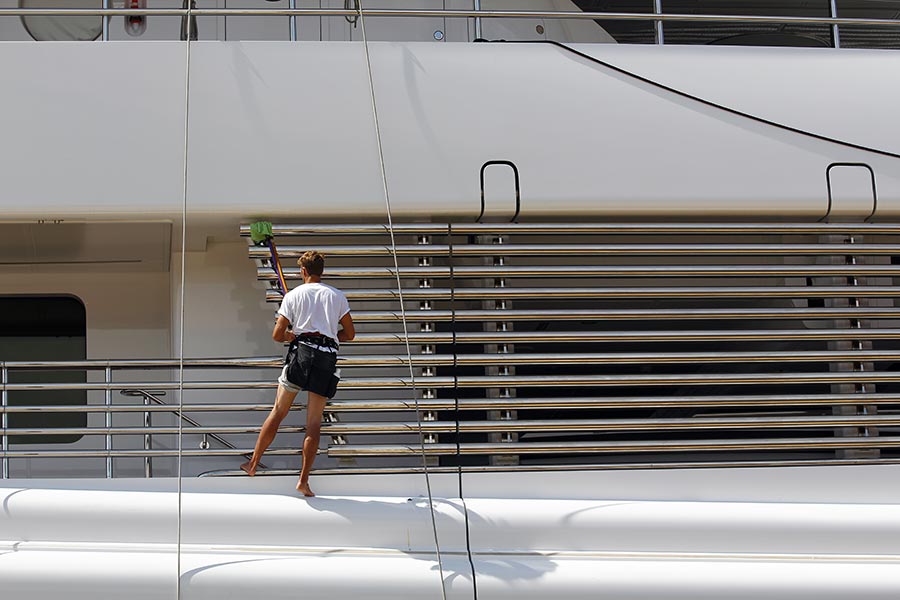
Article reprint — Dockwalk (Crew Tech Talk) — Author: Jorge LangHave you ever noticed a beautiful white yacht with black streaks on the side — or a new 100-meter leaving an oily sheen at a pristine marina?

That particulate matter (PM) — often called soot — is the byproduct of incomplete fuel combustion. Like the black plume from a big-rig truck under acceleration, the same soot is present on marine diesel engines.
Diesel engines work by using high pressures to ignite a fuel/air mixture in the combustion cylinder. When fuel and air don't mix thoroughly before ignition, the byproduct is soot.
The best way to eliminate soot is a Diesel Particulate Filter (DPF) system. These capture soot particles before they're expelled into the environment. The particles are then burned off and disintegrated — a process called filter regeneration — when exhaust-gas temperatures (EGTs) sit between 500–600 °C.
There are many reasons a diesel runs dirty. The most common in marine applications is generators running at low loads. The higher the load on an engine, the higher the EGTs.
Picture a 100 kW generator running at full load 24/7 — EGTs should sit in that continuous-regeneration sweet spot. But when load fluctuates from full down to 50% (overnight, fewer guests), the EGTs fall too. During those low-load periods (below 500 °C), filters accumulate more soot than they burn off. The results: higher back pressure, clogged filters, and more work for an already burdened crew.
That's why selecting the correct DPF for your vessel matters.
There are two types: passive and active. A passive system regenerates on its own as long as EGTs stay between 500–600 °C. At those temperatures the filter burns off more soot than it accumulates — passive systems are ideal for engines that run at constant high loads.
If your engine's load fluctuates, an active system is the better fit. These actively monitor inputs (back pressure, EGTs, engine load) and raise EGTs when needed — usually via a diesel burner or electric heater before the filter.
Done right, a DPF means longer-lasting paint jobs, less work for crew, cleaner decks, no smell at marinas, and no pollutants at sea.
Whether you go active or passive, pick the system that fits your budget and your application.
Author: Jorge Lang — D'Angelo Marine Exhaust brand ambassador with 21 years in the marine industry. +1 954.763.3005 · sales@deangelomarine.com
Whether you're designing a new build, planning a repower, or troubleshooting a smoke or back-pressure issue, our engineers are one phone call away.
Ready to engineer your next exhaust system?
Speak with our team about new installs, repowers, repairs, or SeaClean retrofits — anywhere in the world.