
Types of Marine Exhaust Systems — In Brief
A quick reference on the five main types of marine exhaust systems — dry, underwater, dry stack, wet (water-cooled), and water-separation — with the pros and cons of each.
Dry systems
A diesel exhaust system using lagging (hard coating) or blankets to keep the heat in the tubes the exhaust travels through. Water is sprayed into the exhaust gases at the mixer to cool them.
Advantages
- Less risk of water intrusion into the engine
- Metalwork lasts longer — no retained water in the system
Disadvantages
- Takes up more space
- Higher surface temperature
Underwater exhaust systems
The exhaust exits below the waterline. No main muffler is typically required, though it does require an above-water bypass muffler. The system can be wet or dry, exiting through the stalk (the hole in the bottom of the vessel).
D'Angelo Marine builds to the point of the stalk; the shipbuilder and/or naval architect define the stalk location and hull penetration.
Advantages
- Quieter operation
- Smoke and soot pass through the water and are reduced
- No main muffler required
- No exhaust fumes in the boat
Disadvantages
- Bypass requires an additional hull penetration
Dry stack systems
A diesel exhaust system usually integrated in a tunnel where the exhaust exits topside. Typically the design of choice for turbines, and normally found only on large yachts or commercial vessels.
Wet (water-cooled) systems
A double-tube system. The inner tube carries the exhaust gases; the space between the inner and outer tube carries cooling water. Water is sprayed into the exhaust gases at the mixer to cool them.
Advantages
- Cooler surface temperature
- Less space required
- Can be polished for aesthetic purposes
Disadvantages
- More susceptible to corrosion due to retained water
Water-separation systems
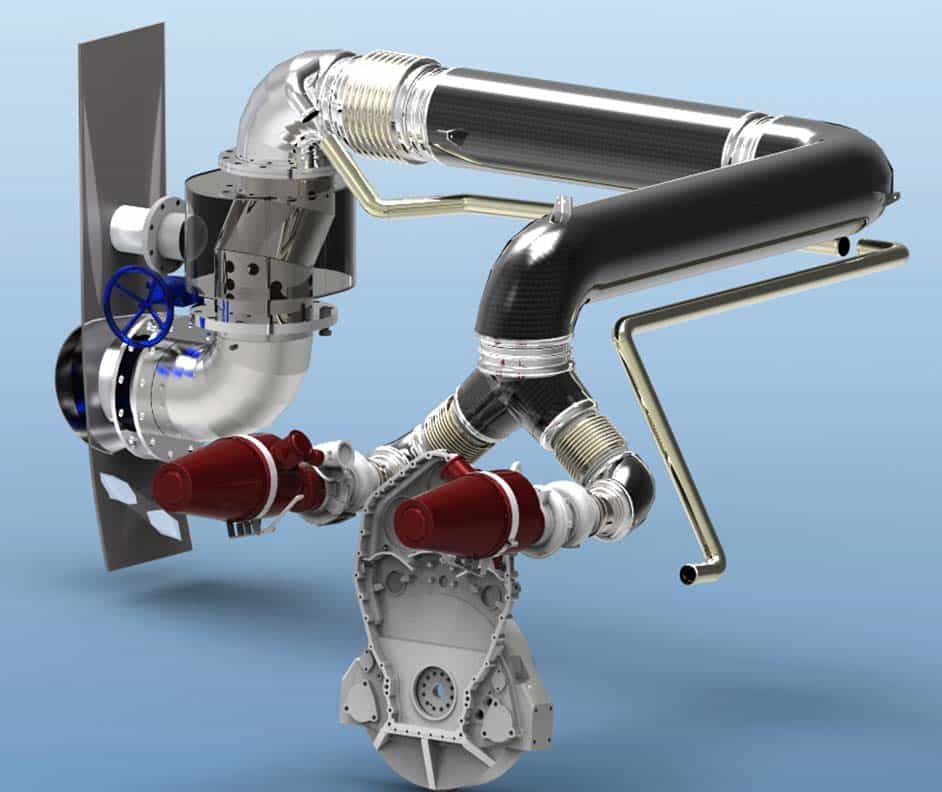
An exhaust system where the water and cooled gas from the mixer are separated so they can be plumbed separately through fiber-reinforced-plastic (FRP) tubing and exit the vessel.
A water-separation system normally exhausts through the hull. The same system exhausting through stacks is called a cool-stack system.
Whether you're designing a new build, planning a repower, or troubleshooting a smoke or back-pressure issue, our engineers are one phone call away.
Ready to engineer your next exhaust system?
Speak with our team about new installs, repowers, repairs, or SeaClean retrofits — anywhere in the world.